Showing posts with label runaway. Show all posts

Sunday, October 10, 2010

The Story of Edgar Sawtelle (2008)

David Wroblewski has written this retelling of Hamlet in a setting of a small dog breeding farm in Winsconsin starring the only son of Gar and Trudy Sawtelle, Edgar, who was born perfect in every way except that he was totally mute. Gar dies, apparently of a heart attack, and his brother, Claude, helps to fill in for the father, both in the business, and in Trudy's life. Understandedly, this does not please Edgar. Like Hamlet, Edgar plans a way to let his uncle know that he is under suspicion for Gar's death.

First, tell them the dogs see everything that happens here, he signed.
What?
Just say it. Say they see everything and they never forget. You'll understand in a minute.
He stood and waited. He thought his mother might ignore his request, but she turned to Mr. Benson and Claude and Doctor Papineau. "Edgar says to tell you that the dogs see" -- she faltered for a moment, then continued -- "That they see everything that happens here, and they never forget."
Edgar was standing before the dogs, looking down the line to make sure they didn't break. He touched Opal under the chin. She looked at him. He released her and she dashed down the aisle to the four of them standing by the workshop. Then he pulled one of the syringes from his shirt pocket. His hand was shaking and as the syringe came out, it snagged another which went clattering to the floor. He snatched it up and placed it in Baboo's mouth.
Tag, he signed. Then he turned to watch.
Baboo trotted down the aisle with the syringe in his mouth. Edgar kept his eyes on Claude, who had caught sight of the syringe. When Baboo reached them, he pressed his nose into Opal's hip, and Opal looked toward Edgar. He gave a small gesture with his right hand. She dropped to the floor and lay on her side.
. . .
Claude stood watching it all. He glanced at the open door, then back at the dogs, then at Edgar.


I have to admit I liked this book in spite of myself. It's not the sort I usually read but I found that frequently I would pick it up and lose a lot of time as I followed Edgar and his dogs through this tragedy. I learned about the Hamlet connection towards the middle of my reading and it added another level to the story, trying to remember Hamlet's story. It would be enjoyed by dog lover's for their major parts in the story.

My recommendation for this book: +++

Sunday, July 18, 2010

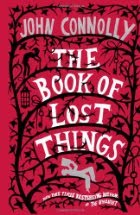
The Book of Lost Things (2006)

This is a delightfully different book by John Connolly which reintroduces us to many of our favorite fairy tales in a story about a Narnia-style link to another world.

David is twelve years old and lives in London during World War I. His mother succumbs to cancer even after all of the twelve-year old things he can do to keep her alive. In short order his father remarries and David finds himself with a baby brother. One night a German airplane crashes in their backyard and David finds a hole in the garden wall that leads to another world. He meets many new people, many familiar from our childhood fairy tales, in his quest to meet the king and find his way back to London, including a sinister character called the Crooked Man.

By bringing all these characters together, Connolly has given us a new fairy tale. It has all the requisite parts - the "abandoned" boy, the evil stepmother, helpers along the way, evil at every turn. David takes all of the events in stride and rises to the occasion at the end and lives happily ever after, sort of.

There is an additional 120 pages at the end of the story where Connolly gives us versions of the fairy tales he incorporates in the book and their backgrounds. I found this extra stuff very informative and fun, especially since I haven't read fairy tales in many, many years. Connolly says,

One of the themes of The Book of Lost Things is the way in which stories and books feed into one another, in much the same way that I, as a writer, have been influenced by the books that I have read. In that sense, The Book of Lost Things is a narrative constructed not only from the books David has encountered, but also from the books and stories that have influenced me.

I wonder what books have influenced me.

My rating for this book: ++++

Thursday, February 4, 2010

Raven Summer (2008)

Raven Summer by Englishman David Almond, is a powerful novel about a young man who learns about the people around him and himself one summer. It opens with Liam and his friend, Max, who follow a noisy and persistent raven and discover an abandoned baby. His parents are arty and rather distracted people but they fall in love with the child and become foster parents for her. In this child we see the beginning of a life story that has tragedy, mystery, and hope.

He is friends with a young scarred girl and a young Liberian man who run away from their foster home. Along the way he learns their stories and a bit about himself as well. Crystal is covered with scars, some are burns inflicted on her and some are cuts inflicted on herself. Henry (aka Oliver) has a particularly heart wrenching past and shares it with his friends. I will not spoil it for the reader by going into particulars.
He looks across the flames at me.
"Perhaps is will always be so," he says. "That fathers wish their children
to live their lives for them. Is it so, Liam?"
I think of Dad: Live like you're in a story, Liam. Live an
adventure.

"Yes," I say. "It is true."

I highly recommend this book. It is a fast read and most everyone will get something out of it.

My rating for this book: ++++

Wednesday, September 9, 2009

Punkzilla (2009)

Stories about runaways are usually not very happy ones as this book by Adam Rapp illustrates. Jamie runs away (goes AWOL) from the military school his Army father put him in. He gets on a bus in Portland, Oregon to join his brother (gay, 8 years older, dying of AIDS), P. Along the way he writes letters to his brother and we read letters he has received from others.

You never know what's out there P like all the murderers and the rapists and the kidnappers and the freaks who have sex with animals or children or both or the weirdos who ride around naked on farm equipment. There's just so much you have to be careful of.

Along the way Jaimie meets all sorts of different people and learns a lot about himself as is true about most journey stories. It is tragic, however, that the one person he could connect with is ultimately unable to help him. There is so much a 14-year old needs to learn from a reliable steady adult and it is unfortunate that Jaimie doesn't have one.

This was a very sad story which would appeal to readers who also prefer emo type music.

My rating for this book: +++

Tuesday, January 6, 2009

Paper Towns (2008)


John Green has already been recognized for Looking for Alaska which won the Printz Award for Young Adult books. Paper Towns is about a high school senior, Quentin, and the girl who lives next door, Margot. She wakes him up in the middle of the night and draws him in to helping her wreak havoc on her ex-boyfriend and other classmates. The next day, she vanishes. The police officer that interviews Quentin mentions that she previously left clues when she ran away but they were unable to find any this time. Quentin is intrigued, however, when someone pulls down the shade in her bedroom (across from his bedroom) and there is a poster of Bob Dylan taped on the outside. This message takes him on a quest to try and discover where she is hiding, if she is indeed still alive.
I recommend this book to mystery lovers, both boys and girls. The road trip that Quentin and his friends take is a bold, desperate attempt at finding Margot and binds them together.
My rating for this book: ++++

Wednesday, August 27, 2008

The Tale of One Bad Rat (1995)

This is a fabulous graphic novel which portrays a young girl who runs away from an abusive household and how she finds herself with the help from, of all people, the author Beatrix Potter. Bryan Talbot is the British author-illustrator who has created this story which takes Helen to the streets of London where she falls in with a group of homeless kids. She finds that one of the unfortunate effects of abuse is being unable to form relationships and ends up running away from them, too. She ends up working in a pub for an older couple in the countryside where Beatrix Potter was inspired to write and illustrate her books. The rest of the story is a satisfying one of self-realization and eventually confronting her parents in order to begin the healing process.
I think anyone who has suffered abuse might find hope in this book and I highly recommend it. The only warning about this book is the heavy use of unfamiliar cockney slang in the street scenes.
My rating for this book: ++++