Showing posts with label England. Show all posts

Thursday, April 18, 2013

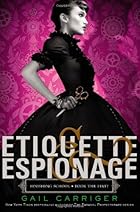
Etiquette & Espionage by Gail Carriger

Etiquette & Espionage
I have enjoyed the adult series by this author called The Parasol Protectorate which features vampires and werewolves in Victorian England. This book takes this already fun format and ramps up the steampunk aspect of it a few dozen notches!

Sophorina is the youngest in a family of girls and when a mysterious Mrs. Barnaclegoose shows up one day offering to take her to a finishing school, her mother is happy, if a bit perplexed, to let her go. Sophorina is such a tomboy, it's hard to imagine anyone could attempt to teach her manners. She packs up a few things and is off. They don't get very far when they are attacked by flywaymen in airdinghies. They are after a prototype and thinks it is in their carriage. They get away thanks to Sophorina's quick thinking and bravado.

The story continues and we learn about Mademoiselle Geraldine's Finishing Academy for Young Ladies of Quality which is suspended in the air by multiple inflated balloons. We meet the young people who surely will factor in future stories and learn about this wonderful steampunk setting.

I highly recommend this to lovers of action, steampunk, or just something completely different. 

My recommendation for this book:   

Sunday, October 10, 2010

The Eyre Affair (2001)

This book by Jasper Fforde was possibly the funniest and most clever I have ever read. One part was so funny I could hardly read I was laughing so hard. Imagine a production of Richard III a la the midnight show of Rocky Horror Picture Show with the audience participation.

Thursday Next is an agent in the Literary Detective Division of the Special Operations Network. She investigates events like characters missing out of classic works like Jane Eyre. An evil fiend, Acheron Hades, has stolen a contraption that allows him to enter original manuscripts and alter the stories in all subsequent editions of the story. Thursday's uncle, Mycroft, was the inventor of the Prose Portal.

"What? What did you say? Mad, did you say? Hmm? Eh? What? What?"

His fingers tightened on Mycroft's windpipe; the professor could feel himself start to sweat in the cold panic of suffocation. Acheron was waiting for an answer that Mycroft was unable to utter.

"What? What did you say?"

Acheron's pupils started to dilate as Mycroft felt a dark veil fall over his mind.

"Think it's fun being christened with a name like mine? Having to live up to what is expected of one? Born with an intellect so vast that all other humans are cretins by comparison?"

Mycroft managed to give out a choke and Acheron slackened his grip. Mycroft fell to the floor, gulping for breath. Acheron stood over him and wagged a reproachful finger.

"Don't ever call me mad, Mycroft. I'm not mad, I'm just . . . well, differently moraled, that's all."

Characters go forward and back in time and pop in and out of the stories in books. Characters from those stories may also pop back into the real world. Curiously, the description of time travel closely resembles the description in the book, The Anubis Gate, by Tim Powers where the analogy uses a frozen river.

". . . The barriers between reality and fiction are softer than we think; a bit like a frozen lake. Hundreds of people can walk across it, but then one evening a thin spot develops and someone falls through: the hole is frozen over by the following morning. . ."

I highly recommend this book for the adventure, the allusions to literature (which do not need to be read), and the humor. I have the next three books in the series and I am eagerly looking forward to reading them.

My rating for this book +++++

Thursday, July 8, 2010

The Ape Who Guards the Balance (1998)

This is the tenth book in the Amelia Peabody series by Elizabeth Peters about a family of archaeologists at the turn of the 20th century. Amelia is the matriarch, Professor Emerson is her husband, Ramses is her son, Nefret her niece, and David, an Egyptian who is as close to Ramses as any brother could be. As I read this book I thought that all of them were always aware of each others' location and occupation like our body is aware of the location and occupation of each of its parts. The point of view alternates between Amelia's and "Manuscript H" which lets us see what is going on with the family members when she is not there to observe.

There was no warning, not even a knock. The door flew open, and he forgot his present aches and pains in anticipation of what lay in store. The figure that stood in the door was not that of an enemy. It was worse. It was his mother.

They are all very proper and very British in their actions and interactions with others. The Professor is given permission to dig in a location that does not hold any promise and he must use all of his best control to not interfere with another archeologist's more exciting dig especially since he knows that the other dig will not be correctly recorded in the rush to unearth new riches. They are all on guard for a master criminal known as Sethos who, despite his six foot height, is also a master of disguise. There is another villain, Bertha, who takes advantage of Amelia's crusade to educate Egyptian girls to better their circumstances.

I really wanted to like this book. I think I would have enjoyed it more if I started with the beginning of this series. After all, it has an undeniably intriguing mix of mystery and Egyptology. I think I will try to find the earlier adventures to see if I like the series better.

My rating for this book: +++

Sunday, June 13, 2010

Little Bee (2008)

This short but powerful book by Chris Cleave is about two women, one middle-aged, one young; one white, one black; one educated, one self-educated; one English, one Nigerian; one free, the other not. The chapters alternate between the two of them as their stories converge, separate, and converge again.

It is a short enough book that giving facts about the plot would give up too much of it. Here is an excerpt from the book:

Three weeks and five thousand miles on a tea ship - maybe if you scratched me you would still find that my skin smells of it. When they put me in the immigration detention center, they gave me a brown blanket and a white plastic cup of tea. And when I tasted it, all I wanted to do was to get back into the boat and go home again, to my country. Tea is the taste of my land: it is bitter and warm, strong, and sharp with memory. It tastes of longing. It tastes of the distance between where you are and where you come from. Also it vanishes - the taste of it vanishes from your tongue while your lips are still hot from the cup. It desappears, like plantations stretching up into the mist. I have heard that your country drinks more tea than any other. How sad that must make you - like children who long for absent mothers. I am sorry.

Two cultures come together and try to help each other as they are able, not enough for either in the end. I highly recommend this book.

My rating for this book: ++++

Sunday, April 18, 2010

The Weed that Strings the Hangman's Bag (2010)

This is the second book in the series by Alan Bradley about the highly intelligent 11-year old Flavia deLuce. She continues to follow her passion for chemistry and poisons and befriends a puppeteer and his assistant after their van breaks down in her town of Bishop's Lacey. While their van is being repaired, they camp out on the grounds of a neighboring farm and promise to put on two shows for the residents of the town. At the end of the second show, the puppeteer is electrocuted. Flavia uses her unique knowledge to help the local constabulary find the guilty party. She is able to flit about the village and learn stuff because few take her seriously.
"You are unreliable, Flavia," he said. "Utterly unreliable."
Of course I was! It was one of the things I loved most about myself.
Eleven-year-olds are supposed to unreliable. We're past the age of being poppets: the age where people bend over and poke us in the tum with their fingers and make idiotic noises that sound like "boof-boof" -- just the thought of which is enough to make me bring up my Bovril. And yet we're still not at the age where anyone ever mistakes us for a grown-up. The fact is, we're invisible - except when we choose not to be.
They are starting to take notice of her, however.
"Dammit!" Inspector Hewitt shouted, leaping to his feet. "Sorry, Vicar. But why haven't we found these things out, Sergeant?"
He glared from one of his men to the other, including both in his exasperation.
"With respect, sir," Sergeant Woolmer ventured, "it could be because we're not Miss de Luce."
Now the long wait for the third book in the series.

My rating for this book: ++++

Thursday, February 4, 2010

Raven Summer (2008)

Raven Summer by Englishman David Almond, is a powerful novel about a young man who learns about the people around him and himself one summer. It opens with Liam and his friend, Max, who follow a noisy and persistent raven and discover an abandoned baby. His parents are arty and rather distracted people but they fall in love with the child and become foster parents for her. In this child we see the beginning of a life story that has tragedy, mystery, and hope.

He is friends with a young scarred girl and a young Liberian man who run away from their foster home. Along the way he learns their stories and a bit about himself as well. Crystal is covered with scars, some are burns inflicted on her and some are cuts inflicted on herself. Henry (aka Oliver) has a particularly heart wrenching past and shares it with his friends. I will not spoil it for the reader by going into particulars.
He looks across the flames at me.
"Perhaps is will always be so," he says. "That fathers wish their children
to live their lives for them. Is it so, Liam?"
I think of Dad: Live like you're in a story, Liam. Live an
adventure.

"Yes," I say. "It is true."

I highly recommend this book. It is a fast read and most everyone will get something out of it.

My rating for this book: ++++

Monday, February 1, 2010

World Without End (2007)

Ken Follett has created another historical fiction masterpiece taking place in 14th century England. As in his other book, Pillars of the Earth, we become acquainted with people from the lowest to the highest, the best and the worst, men and women.

Our two central characters are brothers, Ralph and Merthin. Ralph is, to say the least, cruel. His only joy is inflicting shame, pain, and insult. Merthin, on the other hand, is intelligent and driven to build. His goal is to build the highest cathedral in England. His ideas for constructing bridges and hospitals are inspired but they don't jive with the goals of others, in particular the monks of Kingsbridge.

Women feature prominently in this book, in particular Caris, a bright and caring woman who saves more people from the plague than the aforementioned monks would like to admit.
Merthin went to work with speed and energy. He built cofferdams around the two
problem piers, drained the dams, and began to fill the piers with the piles of
large rough stones he had envisaged from the start. Finally, he would remove
Elfric's ugly iron braces and fill the cracks with mortar. Provided the repaired
foundations were sound, the cracks would not reopen.
But the job he really wanted was the rebuilding of the tower.
It would not be easy. He would have to get his design accepted by the priory the parish guild, currently run by his two worst enemies, Godwin and Elfric. And Godwyn would have to find the money.

Both of these books are massive. World Without End is just over 1000 pages. One feature that makes them fast readers is that the language used by the characters is modern and familiar to the reader. The reader will become intimately involved with the characters and their complicated interactions and feel totally satisfied when the book is finished. I highly recommend this book to readers of historical fiction.

My rating for this book: +++++

Sunday, January 10, 2010

A Land Beyond Ravens (2009)

When I was a teenager I enjoyed the Merlin/Arthur series of books written by Mary Stewart. This book by Kathleen Cunningham Guler took place at the same time (486 A.D.) but the characters are only tangentially connected with Arthur. Warlords and kings vie for power and Christianity is slowly creeping in and taking over the ancient religions. Marcus and his gifted wife, Claerwen have promised to support Arthur when he inherits the crown of Uther Pendragon and are involved with the intrigue and power struggles.

Claerwen straightened her shoulders. So be it, this was not a place for her. And to visit the grove was not the reason she and Marcus had traveled to Ynys Witrin. They had been charged with the secret transport of Gwyar, daughter of the high king Uther Pendragon and his queen Igraine. The young girl of six summers had become a target of political factions that sought to take her hostage or even to assassinate her. In fear Igraine had decided her daughter must be taken to the Lady of Avalon and raised in obscurity.
Another child in hiding. Like Uther's first-born, Arthur. Claerwen wondered where the boy might be by now. He would turn eight in the next winter. Still so young. She thought of Myrddin Emrys as well, the king's nephew and Britain's last high druid, a powerful man and a longtime friend, who had taken Arthur from Igraine's birthing chamber the night the boy was born. Few had been entrusted with the knowledge that Myrddin was raising Arthur - the boy was an even greater target for assassins that the high king himself.


Myrddin, also known as Merlin, meets with Marcus in this story and we see Arthur from afar but the story is really about all that went on behind, beneath, and around the boy. This story was so rich I slowed down my reading to enjoy the language, the history, and the story.

I highly recommend this book to historical fiction fans, especially lovers of the Arthur stories.

My rating for this book: +++ 1/2

Tuesday, December 29, 2009

The Sweetness at the Bottom of the Pie (2009)

11-year old Flavia de Luce is bright, clever, brave, and is like no other 11-year-old I have ever met. Alan Bradley's book had me smiling the whole time I was reading it and I even laughed out loud a few times by Falvia's antics. She lives with her father and two older (and not nearly so clever) sisters in England in 1950. A man shows up at her house one day, argues with her father and then dies in their garden, apparently of poison. By an odd coincidence, Flavia has a fascination with poisons since teaching herself organic chemistry and goes on to investigate this murder.

Having pointed out the body, I watched in fascination as Sergeant Woolmer unpacked and mounted his camera on a wooden tripod, his fingers, fat as sausages, making surprisingly gentle microscopic adjustments to the little silver controls. As he took several covering exposures of the garden, lavishing particular attention on the cucumber patch, Sergeant Graves was opening a worn leather case in which were bottles ranged neatly row on row, and in which I glimpsed a packet of glassine envelopes.
I stepped forward eagerly, almost salivating, for a closer look.
"I wonder, Flavia," Inspector Hewitt said, stepping gingerly into the cucumbers, "if you might ask someone to organize some tea?"
He must have seen the look on my face.
"We've had rather an early start this morning. Do you think you could manage to rustle something up?"
So that was it. As at a birth, so at a death. Without so much as a kiss-me-quick-and-mind-the-marmalade, the only female in sight is enlisted to trot off and see that the water is boiled. Rustle something up, indeed! What did he take me for, some kind of cowboy?

Her investigation leads her to information about the first U.K. stamp known as the Black Penny. Being a stamp collector I found this aspect of the book interesting. Flavia reminds me of Eloise from the series of books by Kay Thompson. She had no fear of grownups and no compunction of sticking her nose in grownup business.

I highly recommend this book to mystery lovers.

My rating for this book: ++++

Monday, December 21, 2009

A Christmas Carol (1843)

Charles Dickens' classic story about Ebenezer Scrooge has always been a favorite of mine in movie form but until now I had never read it. DailyLit offered it in installments through email so I could not resist reading it. What a treat!
I doubt there is anyone who is not familiar with the story of the stingy man who was visited by ghosts and shown how Christmas was more than just an excuse for people to pick his pocket but to share what he had and enjoy the feeling of making others' lives better. What I missed by not reading the book was the amazing language used. The first phrase that stopped me was:

Marley’s face. It was not in impenetrable shadow as the other objects in the yard were, but had a dismal light about it, like a bad lobster in a dark cellar.

Not having studied literature to any length, I don't know if this phrase is common to the era or the creativity of the author, but I loved it. Many of the words I was familiar with since they were used in my favorite version of the movie with Alistair Sim, like the following:

He became as good a friend, as good a master, and as good a man, as the good old city knew, or any other good old city, town, or borough, in the good old world.

While it was fun to get the story in installments, I recommend that the reader gain access to a book with the original illustrations or access them through The Gutenberg Project: http://www.gutenberg.org/files/46/46-h/46-h.htm.

I recommend this book to anyone who has never read it or hasn't read it in a while.

My rating for this book: +++++

Monday, February 23, 2009

The Graveyard Book (2008)

"There was a hand in the darkness, and it held a knife."
So begins Neil Gaiman's book, an ingenious story of how a community (of ghosts) adopted and raised a boy and taught him everything a young man needs to face the world with confidence and independence. The opaque characters are introduced with their epitaphs.
"And so it went, until it was time for Grammar and Composition with Miss Letitia Borrows, Spinster of the Parish (Who Did No Harm to No Man all the Dais of Her Life. Reader, Can You Say Lykewise?)."
The toddler wandered into a London graveyard having slipped from his house while he family was being murdered. Since the ghosts didn't know his name they named him Nobody (Bod for short) and his adoptive parents were a childless couple, Mr. and Mrs. Owens, a elderly but kindly couple. The other ghosts represented all different times in history dating back to before the Roman occupation. In addition to teaching Bod learn how to read, they were able to teach him special abilities such as Fade which helped him hide in plain sight.
Aside from the touching story of an orphan, there is mystery, action, and a touch of horror when Bod discovers areas of the graveyard not visited by the living in ages. His guardian, Silas, is able to leave the graveyard and procure food and other necessities for Bod. As he said, "It is going to take more than just a couple of good-hearted souls to raise this child. It will...take a graveyard." And this village does just that.
This story will appeal to just about anyone who picks it up. In addition to the wonderful story, illustrations by Dave McKean makes this a true treasure.
My rating for this book: +++++

Monday, February 9, 2009

Harry Potter and the Prisoner of Azkaban (2004)

OK, that's it. No more rereading H.P. until summer and the next movie is about to come out. It's just that J.K. Rowling's series of books is so darn addictive!
One of the interesting things that didn't make it to the movie is the major use of chocolate as a remedy for feeling down. I have no doubt in my mind that this is a factual cure and I always head for a bite or two of dark chocolate when I feel stressed. No fiction there! I also had forgotten the role Cruikshanks, Hermione's cat, had in this book. Let's hear it for cats! They can always read a person (or rat) better than other people.
If there is one criticism I could have for this book, it is the speed and ease that Harry went from hating Sirius, believing him to be the cause of his parents' deaths, to loving him when he found outSirius was his godfather. With all of the hiding and treachery going on at a rapid pace, it is amazing that Harry could switch gears from full reverse to full speed ahead in such a short time. Not that Sirius didn't deserve the love, but he was just so infuriatingly slow in revealing himself to Harry. I am also bothered that Harry's father, James, bullied Snape. I don't think Harry ever made the connection between how James harrassed Snape and how Malfoy harrasses Harry and his friends.
One of the best things about working in a high school library and having a teenaged daughter is that these books are available to me and I have a justifiable excuse for reading (and rereading) them.
I think everyone knows about these books and that everyone would enjoy them (again and again).
My rating for this book: +++++

Wednesday, February 4, 2009

Harry Potter 1 (1998) & 2 (1999)


Of course this is not the first time I have read these books. I was sitting watching TV this past weekend and H.P. and the Sorcerer's Stone just happened to be sitting on the table next to me. During the commercials my eyes would wander over to the book and a feeling rose in me that made me open and start to read it. When I finished it, I thought about raiding my daughter's room for the second book and I am now halfway through that one.
It has been a long time since I've read these books and I've watched the movies many times. However, the wonderful feeling of being immersed in a whole new world of magic came back to me all over again. Since we have watched them so many times, when my daughter and I watch the movies, we can recite many of the lines with the actors (to the great annoyance of anyone else in the room). However, going back to the books after 10 years, I found scenes that didn't make it to the movies and it was like reading them for the first time. For instance, in the second book, there is a wonderful deathday party for Nearly Headless Nick, celebrating the 500th anniversary of his death. I had completely forgotten it. It was a prime example of the care J.K. Rowling put into the creation of her books. Even the minor characters (and culture of the exotic ones) get attention so they are brought into the foreground and are not just window dressing.

There are so many books begging to be read that rereading books seems to be unfair to the unread books. Some books are worth the time since new scenes, characters, items, or events take on a whole new significance. These books are so full of unique characters, items, and events it is well worth taking the time sitting with Harry and his friends again.

My recommendation reading or rereading these books: +++++

Wednesday, January 14, 2009

The Savage (2008)


People find different ways to deal with the untimely death of a loved one. This book by David Almond (illustrated by Dave McKean) shows how a boy named Blue deals with the death of his father. A school counselor advises him to write about his loss and he ends up writing a story of a boy who lives like a savage in the woods near his house. The book alternates between the Blue's voice and the story he is writing. His spelling is atrocious but the words make sense if they are pronounced out loud. Mr. Almond comes from England so "football" means soccer and there are other words that are British.

"She laughed and said, 'Will you, now? What kind of job?'
I didn't have a clue, of course.
'One that'll get me loads of dosh,' I said."

This is a very touching and surprising book. I highly recommend it for a quick and satisfying read to practically everyone.

My rating for this book: ++++

Tuesday, December 30, 2008

Midnight Magic (2004)

A reluctant magician, his assistant, a princess in a castle, a ghost, an evil count, secret passages and a missing prince are the ingredients of this delicious little book by Avi. The king calls for the magician, Mangus, to help get rid of a ghost that is haunting his young daughter. Mangus' assistant, Fabrizio, helps solve this mystery by exploring the castle, meeting people, and reporting back to his master. Mangus uses his knowledge of human behavior to try and discover the truth behind the ghost before the princess has to marry the evil Count Scarazoni.
This story takes place in medieval Italy and gives the reader a good idea of what life in a big castle was like. The cover and fly leaves of the book are decorated in medieval style illustrations which attracted me to the book. I enjoyed following Fabrizio around the castle, in and out of secret passages, eavesdropping on, and meeting the other residents of the castle. The ending was not a terrific surprise but I loved following the plot to the end.
A combination of historical fiction and mystery, this book would amuse someone looking for a quick read.
My rating for this book: +++

Tuesday, December 16, 2008

A house Called Awful End


One of the fun aspects of working in a library is finding things that people have left in their books. I have found IDs, money, notes, and scraps of paper. When I opened this book, an index card fell out. Perfect, I thought, a book mark. Drawn on the card was a face with a dark grimace on it. I hoped it wasn't an omen.
This book by Philip Ardagh is very, very, very similar in style to the wonderful Lemony Snicket's Series of Unfortunate Events. The author takes time out of the story to explain expressions to the reader and at one point, the characters of the story even refer to the page number of the book. Unfortunately, the ratio of explanations to story is much higher and much less charming in this story about Eddie Dickens, a young man who has to leave his home to stay with his crazy aunt and uncle until his parents recover from illness. Eddie has none of the gumption of the Beaudelaire children and is pushed around in this book like a empty soda bottle in the ocean. He is even as transparent and empty as the bottle. One thing I liked about Awful End was the explanations about life in England at the time of Charles Dickens.
This book was written for a younger audience and may be enjoyed by readers who also enjoyed the Snicket books.
My rating for this book: ++

Saturday, August 2, 2008

World Without End (2008)

This book takes place in 14th century England in a town called Wigleigh and chronicles the lives of people in various levels of society such as nuns and monks, earls, serfs, and merchants and their relationships between each other. It takes over 1000 pages to tell their stories. One of the things you learn from this book is that it sucked to be a woman during those times and it sucked big time if you were a poor woman. Our characters face one disaster after another: collapsed bridge and cathedral, plague, rape, famine and all the other things people had to live through at that time. No electricity, steam engines, or printing press to make life easier. The only technological advance was the loom. But through it all, people fell in love, had babies and raised them, and made do the best they could. Giving up was not an option for these folks.
This is indeed a hefty book but it reads fast. Conversations and descriptions aren't very deep and you get caught up in the battle of good and evil and you are carried along in the currents that carry our characters through their lives.
I read this book in my car while my daughter was in meetings. It definitely helps having a place to read with little distraction.
I highly recommend this book to people who enjoy historical fiction and aren't intimidated by large books.
My rating for this book: +++++