Showing posts with label adventure. Show all posts

Monday, March 25, 2013

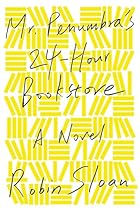
Mr. Penumbra's 24-Hour Bookstore: A Novel by Robin Sloan

Mr. Penumbra's 24-Hour Bookstore
This was definitely a cool book! It takes the reader from a little bookstore in San Francisco to the Google campus in Palo Alto to a subterranean library in New York City to a knitting museum and a conservatory of artifacts. 

Clay Jannon had a job designing a web site for a bagel company but unfortunately it folded and now he has to look for a job. One day as he was walking around San Francisco he sees a sign offering a job in the window of a really small bookstore. He walks in and finds that what the bookstore lacks in floor space makes up for it in wall space. Shelves full of books go up for three stories and are accessed by ladders on wheels. However, he has to agree to some very strange rules before he can have the job. He agrees to the conditions and gets the shift that runs from 10 pm to 6 am. Not surprisingly, there are not so many customers that come into the store, just a few who exchange one book for another. Clay records these visits in a log that is the newest in a set that dates back for decades. Curiosity overcomes Clay who feels that there is much more to this store than meets the eye.

I highly recommend this book to readers who love mysteries, adventure, and, of course, books!

My rating for this book:

Tuesday, February 26, 2013

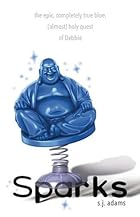
Sparks: The Epic Completely True Blue, (Almost) Holy Quest of Debbie by S.J. Adams

Sparks
Debbie Woodlawn has kept a secret since sixth grade. She has a crush on her best friend, Lisa, and has to share this with her before Lisa makes out with a boy. She gets assistance from two kids, members of a self-formed Church of Blue. One of the things they do in this church is create a list of quests, such as seeing a person completely nude. Finding Lisa is a perfect quest.

The three of them dash around town trying to catch up with Debbie's backpack, get something to eat, find out where Lisa is going on her date, and all on $5.00. Overseeing this endeavor is the blue-painted Buddha on the dashboard.

It must be so hard to harbor a secret like this for so long. It does not help that Debbie lives in the Bible Belt and to be near her friend, joins a group called Active Christian Teens. Even a New Age mother doesn't see anything bothering her daughter. But Debbie must tell Lisa and find out if she has any chance at developing a relationship with her.

I recommend this book as a fun romp with the added bonus of a coming-of-sexuality story.
My rating for this book: 
 

Sunday, November 7, 2010

The Well of Lost Plots (2003)

This is the third book in the Thursday Next series by Jasper Fforde. In this book, Thursday is in the Character Exchange Programme and is in hiding in an out-of-print book replacing a character that will spend some time in the real world. She is going to stay here until her child is born. In the meantime she is studying to be a Jurisfiction agent in the Book World with the help of her mentor Miss Havisham (from Great Expectations). Her grandmother, Gran Next, pops in to make sure that she doesn't lose any memories of her husband because that would indicate an attack by the mnemonomorph Aornis, sister to Acheron Hades, who was killed by Thursday in the first book. Another threat to books everywhere is the introduction of a new program called UltraWord which is supposed to create more than the eight plot lines that all novels derive from.

Whew! That's a lot in one book. Besides all this is the introduction of all sorts of creatures like the "vyrus" which changes the spelling of words with predictably dangerous results. One of my favorite parts was an exchange about the overuse of had had and that that and how it confused the reader too much.

"Take the first had had and that that in the book by way of example," explained Lady Cavendish. "You would have thought that that first had had had had good occasion to be seen as had, had you not? Had had had approval but had had had not; equally it is true to say that that that that had had approval but that that other that that had not."
"So the problem with that other
that that was that --?
"That that other-other
that that had had approval."
"Okay," said the Bellman, whose head was in danger of falling apart like a chocolate orange, "Let me get this straight:
David Copperfield, unlike Pilgrim's Progress, which had had had, had had had had. Had had had had TGC's approval?"
There was a very long pause.

I put Jasper Fforde in the same high realm as J.K. Rowling and Terry Pratchett for his ability to create a new world with original creatures and physics, he is that good.

My rating for this book: ++++

Sunday, October 10, 2010

The Eyre Affair (2001)

This book by Jasper Fforde was possibly the funniest and most clever I have ever read. One part was so funny I could hardly read I was laughing so hard. Imagine a production of Richard III a la the midnight show of Rocky Horror Picture Show with the audience participation.

Thursday Next is an agent in the Literary Detective Division of the Special Operations Network. She investigates events like characters missing out of classic works like Jane Eyre. An evil fiend, Acheron Hades, has stolen a contraption that allows him to enter original manuscripts and alter the stories in all subsequent editions of the story. Thursday's uncle, Mycroft, was the inventor of the Prose Portal.

"What? What did you say? Mad, did you say? Hmm? Eh? What? What?"

His fingers tightened on Mycroft's windpipe; the professor could feel himself start to sweat in the cold panic of suffocation. Acheron was waiting for an answer that Mycroft was unable to utter.

"What? What did you say?"

Acheron's pupils started to dilate as Mycroft felt a dark veil fall over his mind.

"Think it's fun being christened with a name like mine? Having to live up to what is expected of one? Born with an intellect so vast that all other humans are cretins by comparison?"

Mycroft managed to give out a choke and Acheron slackened his grip. Mycroft fell to the floor, gulping for breath. Acheron stood over him and wagged a reproachful finger.

"Don't ever call me mad, Mycroft. I'm not mad, I'm just . . . well, differently moraled, that's all."

Characters go forward and back in time and pop in and out of the stories in books. Characters from those stories may also pop back into the real world. Curiously, the description of time travel closely resembles the description in the book, The Anubis Gate, by Tim Powers where the analogy uses a frozen river.

". . . The barriers between reality and fiction are softer than we think; a bit like a frozen lake. Hundreds of people can walk across it, but then one evening a thin spot develops and someone falls through: the hole is frozen over by the following morning. . ."

I highly recommend this book for the adventure, the allusions to literature (which do not need to be read), and the humor. I have the next three books in the series and I am eagerly looking forward to reading them.

My rating for this book +++++

Sunday, July 18, 2010

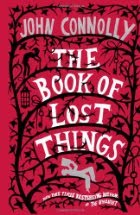
The Book of Lost Things (2006)

This is a delightfully different book by John Connolly which reintroduces us to many of our favorite fairy tales in a story about a Narnia-style link to another world.

David is twelve years old and lives in London during World War I. His mother succumbs to cancer even after all of the twelve-year old things he can do to keep her alive. In short order his father remarries and David finds himself with a baby brother. One night a German airplane crashes in their backyard and David finds a hole in the garden wall that leads to another world. He meets many new people, many familiar from our childhood fairy tales, in his quest to meet the king and find his way back to London, including a sinister character called the Crooked Man.

By bringing all these characters together, Connolly has given us a new fairy tale. It has all the requisite parts - the "abandoned" boy, the evil stepmother, helpers along the way, evil at every turn. David takes all of the events in stride and rises to the occasion at the end and lives happily ever after, sort of.

There is an additional 120 pages at the end of the story where Connolly gives us versions of the fairy tales he incorporates in the book and their backgrounds. I found this extra stuff very informative and fun, especially since I haven't read fairy tales in many, many years. Connolly says,

One of the themes of The Book of Lost Things is the way in which stories and books feed into one another, in much the same way that I, as a writer, have been influenced by the books that I have read. In that sense, The Book of Lost Things is a narrative constructed not only from the books David has encountered, but also from the books and stories that have influenced me.

I wonder what books have influenced me.

My rating for this book: ++++

Monday, July 12, 2010

The Magicians (2009)

I think Lev Grossman wrote this book for the adults who have read Harry Potter, Narnia, and other classic fantasies. Magic in those worlds was taken for granted and the question about where it comes from is not considered. The young people who find themselves in the Brakebills School take the training in stride but when they graduate they question what they can use their skills for. One of their instructors named Fogg asks them this question.

"Sometimes I wonder if man was really meant to discover magic," Fogg said expansively. "It doesn't really make sense. It's a little too perfect, don't you think? If there's a single lesson that life teaches us, it's that wishing doesn't make it so. Words and thoughts don't change anything. Language and reality are kept strictly apart - reality is tough, unyielding stuff, and it doesn't care what you think or feel or say about it. Or it shouldn't. You deal with it, and you get on with your life."

The central character, a mathemathically brilliant young man named Quentin, has always been fascinated by a series of books called Fillory and Further about two brothers and their two sisters who discover a hidden world called Fillory (sound familiar?). Throughout his time in Brakebills he hopes to be able to access Fillory which, he is convinced, is real and where he feels he will find a home. After their graduation Quentin and his friends embark on a vacation to find adventure in Fillory.

The reader will enjoy nods to several fantasy classics. The venture of these young people is difficult and painful at times but the reader is carried on to see if they succeed in finding Fillory and their place in this or any other world.

Fun quote: The thick plottens.

My rating for this book: +++


Tuesday, April 27, 2010

Going Bovine (2009)

Libba Bray has certainly deserved the Printz Award for this book. It is a twist on Don Quixote where Cameron, a young man suffering from mad cow disease, takes his hospital roommate on an amazing adventure.

One of the places they visit is CESSNAB.

"What's CESSNAB?" I ask.
"It's this place." Daniel spreads his arms wide.
"It stands for Church of Everlasting Satisfaction and Snack 'N' Bowl."
"So it's a church" I say quickly.
"It's everything. Stores. School. Bowling alley. We've got everthing we need right here. Cool, huh?"
Sounds nice until we find out that you never bowl less than a perfect score, the only flavor of milkshake is vanilla, and everybody is happy, happy, happy. They also visit an Infinity Collider and end up in Daytona, Florida in time for spring break.

We follow Cameron and Gonzo on their desperate quest and meet many different characters like an angel named Dulcie and a talking lawn gnome named Balder.

I give this book as high a rating as I can and recommend it to everyone.

My rating for this book: +++++

Friday, March 19, 2010

The Forest of Hands and Teeth (2009)

This novel by Carrie Ryan received rave reviews and I am at a loss as to why.

Mary lives in a small village surrounded by a fence which keeps out previous inhabitants who were infected and "turned" into the Unconsecrated, flesh-eating undead (shuffling and moaning). As the story starts, her bereft mother, cannot live without her husband (already turned) and willingly allowed one to bite and infect her. As she dies and turns, she is forced out of the village. Mary grieves but has to carry on and face her own betrothal. Since the village has lost so many of its people, it is of the utmost importance that young people join and procreate. Before her ceremony is completed, the fences give way to the press of Unconsecrated and Mary and a small group of family and friends escape through a fenced tunnel to find other villages and the ocean.

But there are times when I stand at the edge of the Forest of Hands and
Teeth and look out at the wilderness that stretches on forever and wonder
what it would be like if it were all water. I close my eyes and listen to
the wind in the trees and imagine a world of nothing but water closing over
my head.
It would be a world without the Unconsecrated, a world without the
Forest of Hands and Teeth.

Mary is torn between the need to discover what is outside the fence and the need to do what is necessary to help her village. She is also torn between her feelings for Travis and her duty to Harry, his brother, who asks to join with him. While she should be enjoying her last days of freedom, she is in constant danger from what is outside the fence. I would like this story and this character if I could only lose the images from movies like Night of the Living Dead.

Fantasy and adventure readers would enjoy this book.
My rating for this book: +++ 1/2

Sunday, March 14, 2010

The Anubis Gates (1983)

Tim Powers has written a complex race back and forth through time in this book. Brendan Doyle agrees to host a party of people back through time to listen to Coleridge give a speech in a pub in 1846 London in an event designed by J. Cochran Darrow who tries to describe the time travel as a river covered with ice.

"Right - picture holes in that ice roof; now if part of your lifetime, some section of the seventy-year-long trailing weed that's you, should happen to be under one of the holes, it's possible to get out of the time stream at that point."
"To where?" Doyle asked guardedly, trying to keep any tone of pity or derision out of his voice. Why, to Oz, he thought, or Heaven, or the Pure Vegetable Kingdom.
"Nowhere," answered Darrow impatiently. "Nowhen. All you can do is enter again through another gap."

Unfortunately, Doyle is snatched before the group returns to the area where they return to their real time and he is stuck without money, clothes, or any means to get back. He tries to locate a gypsy who was somehow involved with the time shifts and ends up encountering beggar kings, a body-shifting mass murderer and a woman disguised as a man. The book is non-stop action through the streets, and sewers of London.

So what the hell happened, gang? Doyle thought. The "hellish retinue" sounds ominous . . . and what do you mean by "the Connexion"? He flipped hopelessly to the back of the books, and his eye was caught by a very short note written clearly on the endpaper.
He read it, and for the first time during all his adventures and mishaps he actually doubted his sanity.
The note read: "IHAY, ENDANBRAY, ANCAY OUYAY IGITDAY?" -- and it was in his own handwriting, though the ink was as faded with age as every other notation in the book.
Suddenly dizzy, he sat down on a stack of books, which exploded to dust under his weight, spilling him backward agains onther pile, which toppled down upon him, burying him in damp, disintegrating parchment and showers of panicked spiders and silverfish.

When I finished this book I felt I had just gotten off a wild roller coaster ride. I almost wished I had tried to chart the characters through the time and body changes to see how it would look.

This book was a bit of a challenge to read but I am very happy I finished it.

My rating for this book +++ 1/2

Sunday, January 24, 2010

Leviathan (2009)

Scott Westerfeld has created an alternate history where Europe has two facing sides; the Clankers and the Darwinists. The Clankers, from eastern Europe, have developed mechanical machines that mimic the movement of animals and the Darwinists, from western Europe, have fabricated animals to be their war machines.
But Deryn's favorite lectures were when the boffins explained natural philosophy. How old Darwin had figured out how to weave new species from the old, pulling out the tiny threads of life and tangling them together under a microscope. How evolution had squeezed a copy of Deryn's own life chain into every cell of her body. How umpteen different beasties made up the Leviathn - from the microscopic hydrogen-farting bacteria in its belly to the great harnessed whale. How the airship's creatures, like the res of Nature, were always struggling among themselves in messy, snarling equilibrium.
Alek finds himself orphaned, his father Austrian Duke Ferdinand and his less-than-royally born mother have been killed. Alek is spirited away by two of the Duke's men who take him to a hideaway in the Alps, set up for just an occasion. Deryn is a young English woman who disguises herself as a man (Dylan) to enter the British Air Service and gets a position on the Leviathan, a fabricated whale with the ability to generate enough hydrogen to take it aloft. When taking a secret cargo to the Ottoman Empire, they are attacked and crash in, you guessed it, the Alps.
Deryn had always reckoned herself a tomboy, between Jaspert's bullying and Da's balloon training. But running with the other middies was mroe than just punchups and tying knots - it was like joining a pack of dogs. They jostled and banged for the best seats at the middies' mess table. They taunted each other over signal reading and navigation scores, and whom the officers had complimented that day. They endlessly competed to see who could spit farther, drink rum faster, or belch the loudest.
It was bloody exhausting, being a boy.
This exciting action is enhanced by illustrations by Keith Thompson which help the reader get a vision of the size and complexity of the machines described. There will be a sequel to continue the action. This is a real page turner with nonstop action. I highly recommend this book to science fiction and war fiction readers.

My rating for this book: ++++

Tuesday, December 29, 2009

The Sweetness at the Bottom of the Pie (2009)

11-year old Flavia de Luce is bright, clever, brave, and is like no other 11-year-old I have ever met. Alan Bradley's book had me smiling the whole time I was reading it and I even laughed out loud a few times by Falvia's antics. She lives with her father and two older (and not nearly so clever) sisters in England in 1950. A man shows up at her house one day, argues with her father and then dies in their garden, apparently of poison. By an odd coincidence, Flavia has a fascination with poisons since teaching herself organic chemistry and goes on to investigate this murder.

Having pointed out the body, I watched in fascination as Sergeant Woolmer unpacked and mounted his camera on a wooden tripod, his fingers, fat as sausages, making surprisingly gentle microscopic adjustments to the little silver controls. As he took several covering exposures of the garden, lavishing particular attention on the cucumber patch, Sergeant Graves was opening a worn leather case in which were bottles ranged neatly row on row, and in which I glimpsed a packet of glassine envelopes.
I stepped forward eagerly, almost salivating, for a closer look.
"I wonder, Flavia," Inspector Hewitt said, stepping gingerly into the cucumbers, "if you might ask someone to organize some tea?"
He must have seen the look on my face.
"We've had rather an early start this morning. Do you think you could manage to rustle something up?"
So that was it. As at a birth, so at a death. Without so much as a kiss-me-quick-and-mind-the-marmalade, the only female in sight is enlisted to trot off and see that the water is boiled. Rustle something up, indeed! What did he take me for, some kind of cowboy?

Her investigation leads her to information about the first U.K. stamp known as the Black Penny. Being a stamp collector I found this aspect of the book interesting. Flavia reminds me of Eloise from the series of books by Kay Thompson. She had no fear of grownups and no compunction of sticking her nose in grownup business.

I highly recommend this book to mystery lovers.

My rating for this book: ++++

Friday, December 11, 2009

Hush (2007)

Donna Jo Napoli writes stories based on fairy tales and this book is based on a story from an Icelandic saga about a girl named Melkorka who was bought by an Icelandic man named Hoskuld and takes her back to his home. In our book, Melkorka is an Irish princess who was kidnapped when trying to escape her town before the Vikings invaded. She is advised by another slave to pretend to be mute so that her pride and arrogance wouldn't end up getting her beaten or worse.

In the night someone rolls agains me as we lie sleeping. I open my eyes to see Maeve's eyes shining at me in the moonlight. "He's convinced you are an aist - a stork," she whispers. "A stork who has the power to chage form into a woman. He thinks you may be a charodeitsa - an enchantress, but unlike our Irish piseogai, he fears you could be evil. It's only how clean and pretty you are that keeps him from quaking."

Melkorka was sold by the Russian kidnappers to an Icelandic sailor named Hoskuld. She continues to learn about these hard, rough, people from the north and about herself in the process. Her intelligence serves her well by quickly picking up languages and knowledge about healing from another slave.

Life in these northern places was cold, dark, and cruel. By following Melkorka on her voyage we learn about these early civilizations. She was a remarkable girl who wisely used her wits to stay alive. I recommend this book to historical fiction fans.

My rating for this book: ++++

Sunday, December 6, 2009

A Monstrous Regiment of Women (1995)

Laurie R. King's series of detective stories feature a young woman, Mary Russell who develops a deep relationship with Sherlock Holmes. She is very bright and uses her tomboyish looks to dress as a man and get into places women cannot.

In this story, she is intrigued by a group of women who meet for spiritual and inspirational meetings. Danger lurks, however, and several members of the church mysteriously meet fatal ends after changing their wills, leaving everything to this church.

Holmes helps her discover the truth and their relationship reaches a new height.

These books are fun diversion and I will continue to slowly make my way through them as I find old copies in used book stores.

I recommend this book to mystery lovers who have a special attraction to Sherlock Holmes stories.

My rating for this book: +++

Thursday, June 25, 2009

Dog On It (2009)

I read once that a dog appearing on the cover of a book means the dog dies by the end but I didn't think of that when I bought this book by Spencer Quinn and luckily that maxim didn't hold true this time! Chet tells the story of how he and his master, Bernie Little, solved the case of a missing teen-aged girl named Madison. Luckily Chet understands a lot of human words and can relate their conversations to the reader. We also learn a lot about his world through smells and sounds.

We learn that his favorite things are steaks, riding in cars, and Bernie, who adopted Chet when he failed to get his K-9 certification.

"'What's with you right now?'
Nothing, nothing was with me: stoned out of my mind, that was all. I got my tongue back in my mouth; it was all dried up from the wind, felt more like one of those towels I sometimes found on the laundry-room floor. I liked burying those towels out in the backyard near the big rock, but burying towels was never easy. The chew strips - that was another matter, easy to bury and - Whoa! At that moment I had a very faint memory of burying one that I hadn't dug up yet, near the orange tree by old man Heydrich's fence. Maybe it was still there! I was gazing up at the moon and making plans when we turned in to a driveway and came to a stop behind Cynthia Chambliss's car."

Chet is an amazing dog, quick to respond to Bernie's commands and independent enough to end up in all sorts of predicaments, like time spent in a dog pound. That was a close one! Like most dogs, he doesn't have the best memory except when it comes to scents and can be easily distracted by things to eat or chase.

I give this book a hearty recommendation to people who love dogs and mysteries, two of my favorite things! And no, Chet doesn't die because Mr. Quinn is writing more books! I can't wait!

My rating for this book: +++++

Thursday, June 18, 2009

Heroes of the Valley (2009)

After enjoying the Bartimeaus series so much, I was thrilled to see that Jonathan Stroud had a new book out and I was not disappointed.


We all grow up with stories that are so real to us they are like memories. We don't doubt their veracity since they have been handed down to us by our parents who heard them from their parents, and so on. Halli Sweinsson doubts the stories he was told from birth about his ancestors and Trows, monsters who lived all around their lands. Were the stories real? Halli, the second son of his town's leader, wanted to learn the truth and maybe make his own legends.

Like most of us, Halli is not perfect. He is much shorter than his brother and much smarter with a wonderful sense of humor (I found myself chuckling out loud). Everyone only notices his stature, however, and they all fail to appreciate his intelligence and wit, except for Aud, the daughter of another town's leader. Together they are quite a team.

Adventurers and action lovers will enjoy this book.

My rating for this book: ++++

Wednesday, May 20, 2009

Heart of Darkness (1899)

"Droll thing life is--that mysterious arrangement of merciless logic for a futile purpose. The most you can hope from it is some knowledge of yourself--that comes too late--a crop of unextinguishable regrets. "

It took me a while to reread Joseph Conrad's book because I found that so often I would stop and read over a particular sentence twice or three times over because of the fascinating was he uses language. The excerpt quoted above is an example. Of course, the more times I read this, the more depressed and desperate I felt. Not exactly an upbeat book.

Read this book slowly (it's not very long anyway) and fix each image in your mind and feel each emotion in your heart to get the full effect.

After you have read this book, rent the movie Apocalypse Now (1979) starring Marlon Brando, Martin Sheen, Robert Duvall, Laurence Fishburne, Harrison Ford, and Dennis Hopper. It is based on Heart of Darkness but takes place in Viet Nam. You may have heard the tag line, "I love the smell of napalm in the morning."

I read this book via DailyLit. Somehow I managed to have a window on my iGoogle page with one installment a day and also receive four installments each day on the Google reader. It is fun to get a piece of a book each day but my eyes still get strained reading on a computer screen, especially when I read something over and over again. I think I'll stick with books.

Wednesday, January 7, 2009

Caliber (2009)

The artwork of Garrie Gastonny and the story by Sam Sarkar go together to make this retelling of the Arthur and Merlin tale an amazing book. Set in the old west, Excalibur the sword becomes Caliber the six-shooter (don't you just love the pun?) and Merlin the magician is a shaman named Jean Michel. Arthur is Arthur and accidentally discovers that he is the only one able to use Caliber. He goes on to fight evil always standing up for the law, never giving in to feelings of revenge.

The artwork is positively stunning. The glossy heavyweight pages help make the detail stand out vividly. The only warning I have for readers is the graphic violence. However, the story and the era it is placed in were violent so it is to be expected.

I recommend this to all graphic novel fans and to readers looking for an interesting twist on an old story.

My rating for this book: +++++

Tuesday, December 16, 2008

A house Called Awful End


One of the fun aspects of working in a library is finding things that people have left in their books. I have found IDs, money, notes, and scraps of paper. When I opened this book, an index card fell out. Perfect, I thought, a book mark. Drawn on the card was a face with a dark grimace on it. I hoped it wasn't an omen.
This book by Philip Ardagh is very, very, very similar in style to the wonderful Lemony Snicket's Series of Unfortunate Events. The author takes time out of the story to explain expressions to the reader and at one point, the characters of the story even refer to the page number of the book. Unfortunately, the ratio of explanations to story is much higher and much less charming in this story about Eddie Dickens, a young man who has to leave his home to stay with his crazy aunt and uncle until his parents recover from illness. Eddie has none of the gumption of the Beaudelaire children and is pushed around in this book like a empty soda bottle in the ocean. He is even as transparent and empty as the bottle. One thing I liked about Awful End was the explanations about life in England at the time of Charles Dickens.
This book was written for a younger audience and may be enjoyed by readers who also enjoyed the Snicket books.
My rating for this book: ++

Thursday, November 20, 2008

Redwall (2002)

Several years ago I had the pleasure of hearing the author of Redwall, Brian Jacques, speak. He said he started writing when he was unable to find good, descriptive books to read aloud at a school for the blind. That's why his books are so rich with description.
"Cluny was a bilge rat; the biggest, most savage rodent that ever jumped from ship to shore. He was black, with grey and pink scars all over his huge sleek body, from the tip of his wet nose, up past his green and yellow slitted, eye, across both his mean tattered ears, down the length of his heavy vermin-ridden back to the enormouse whiplike tail which had earned him his title: Cluny the Scourge!"
The parallels to The Lord of the Rings are too numerous to mention but mice, shrews, and sparrows (men, dwarves, and elves) fight off invasion from rats (orcs). Frodo, oops, I mean Harry Potter, er, I mean Matthias, discovers his destiny to follow in the footsteps of Martin the Warrior. The resemblance between Matthias and an image of Martin in a tapestry had gone unnoticed until the abbey was threatened. He goes on a quest to recover Martin's sword to help defend Redwall Abbey from the rats. While leaving his friends behind to fend for themselves, he faces dangers and meets new allies along the way to recovering this valuable artifact.
I had been meaning to read Redwall for many years and I am glad I finally did. I doubt I will read the entire series (ah, the old problem of so many books and too little time) but it is not because I wouldn't enjoy them.
I recommend this book to fans of adventure books. It's an enjoyable good vs. evil story.
My rating for this book: +++

Wednesday, August 27, 2008

The Quest of the Fair Unknown (2008)

Imagine that you were born in the forest and grew up knowing only your mother. Imagine that just before she died she told you only that your father was a knight of the Round Table. Off you go in the world with only that knowledge. Beaufils (his mom's name for him which translates to "handsome son") goes off in search of his father. Well, it seems that almost everyone he meets in off in search of one thing or another. During this time in history, if there wasn't anything going on, the kings would send the knights off on quests so they wouldn't hang around fighting each other. Beaufils finds his way to Camelot, meets King Arthur, and realizes that finding out who his father is will not be as easy as he thought.
This book reminded me of The Little Prince, a French book about a boy who leaves his home planet and meets a lot of interesting characters. I love the subtle humor in this book.

"Does everyone have a title?" Beaufils asked.
"No," Gawain replied. "It's a special privilege, and the people who have a title sometimes
think it makes them very special indeed."
Beaufils smiled at Gawain's witticism. He had to be joking, of course; Beaufils knew that
people would never really think they were special just because of extra words tacked onto
their name.

Readers who enjoy Round Table stories will love this book and others by this author.
My rating for this book: ++++